

Into the Mangroves — Where the River Has a Pulse
There is nothing quite like the moment a canoe slides into a mangrove forest.
The sounds change first. The open air gives way to something closer, more enclosed — bird calls bouncing off the water, the dip of the paddle, the occasional rustle of something moving in the roots along the bank. The Ramisi River winds through the mangrove jungle like a secret corridor, and your guide navigates it with the ease of someone who has done this a thousand times and still finds it beautiful.
Keep your eyes low and slow.
The crocodiles are here — resting on mudbanks, half-submerged at the water’s edge, watching your canoe pass with ancient, unhurried patience. They are not performing for you. They simply live here, as they have for millions of years, in one of the most intact coastal ecosystems on the East African coast.
Above you, the mangrove canopy is alive with exotic birds — kingfishers flashing electric blue, herons standing perfectly still, species that dedicated birdwatchers travel thousands of kilometres specifically to see. Your guide knows them all by name.
This stretch of river is the kind of place that makes you put your phone down and simply look.
The Sandbar — An Ocean Pause
The mangroves release you gradually, the river widening until suddenly the Indian Ocean opens up ahead of you — vast, turquoise, and sparkling in the late morning sun.
Your guide anchors at a small sandbar rising from the water like a secret — a sliver of white sand surrounded by nothing but ocean in every direction.
This is your moment to swim.
The water here is warm and clear and completely unhurried. A cold soft drink appears from the cooler. You float on your back, staring up at an open Kenyan sky, and wonder briefly how you almost missed this entirely.
Funzi Island — Lunch at the Edge of the World
From the sandbar, you sail to Funzi Island — a small, largely untouched island where the pace of life is determined by tides rather than timetables.
Lunch at Funzi Sea Adventures Lodge is the kind of meal that earns its setting. Fresh fish pulled from the same ocean you just swam in. Seafood prepared the way the coast has always prepared it — simply, confidently, with flavours that remind you that the best food rarely needs much explanation.
Eat slowly. You have time.
Dolphins on a Dhow — The Afternoon Surprise
After lunch, the day produces one more extraordinary chapter.
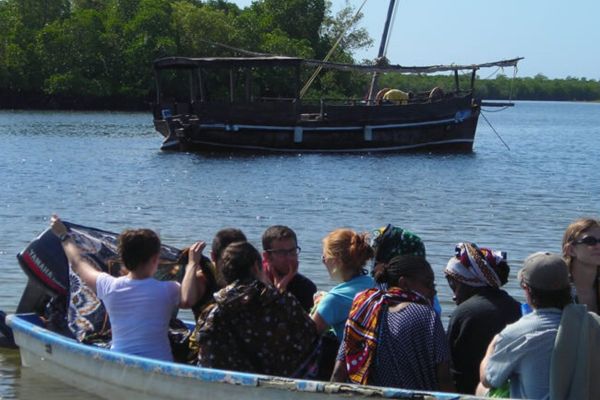
You board a traditional Swahili dhow — the same style of wooden sailing vessel that has navigated this coastline for centuries — and head out into the open ocean.
The dolphins find you.
They almost always do. They appear at the bow first, riding the pressure wave created by the dhow, leaping and turning with a playfulness that feels almost deliberate — as though they know they have an audience and have decided to perform anyway. Watching them from the deck of a traditional dhow, with the Kenyan coastline on the horizon and the afternoon light turning everything golden, is one of those experiences that simply cannot be adequately described. It has to be felt.
Bodo Village — The Walk That Grounds Everything
As the dhow brings you back to Bodo Jetty, the day makes one final, gentle turn.
Your guide takes you on a short walk through Bodo Village — the small coastal community that lives alongside everything you experienced today. Children wave from doorways. Fishermen tend their nets. The smell of woodsmoke and salt and the day’s last cooking fires drifts through the narrow paths between homes.
This is not a staged cultural performance. It is simply a community going about its evening — and being generous enough to let you walk through it.
It is the kind of moment that puts everything else into perspective. The crocodiles, the dolphins, the sandbar, the dhow — all of it was extraordinary. But this quiet walk through a Kenyan village, at the end of a day that took you somewhere most tourists never go, is what turns a great trip into something that actually changes how you see the world.
Evening — Back to the Hotel
The drive back to your hotel is quiet in the best possible way. The kind of quiet that comes not from having nothing to say, but from having so much to process that words feel slightly inadequate.
You left this morning a coastal traveller looking for something beyond the beach.
You return with crocodile sightings, dolphin memories, a stomach full of fresh Swahili seafood, and a genuine encounter with one of Kenya’s most authentic coastal communities.
And it was just one day.
This excursion departs from hotels along the Mombasa and Diani Beach coastline and is available as a private, fully guided day trip with Blossom Kenya Safaris. Group bookings for friends, families, and corporate teams are warmly welcomed.
 +254 702 940 163
  Chat with us on WhatsApp